Most of us have been undone by a piece of music at least once — caught off guard in the car, at a funeral, three notes into a song we didn’t know we still remembered. Music gets past the intellect and reaches something we usually keep guarded. You needn’t be religious to know the feeling.
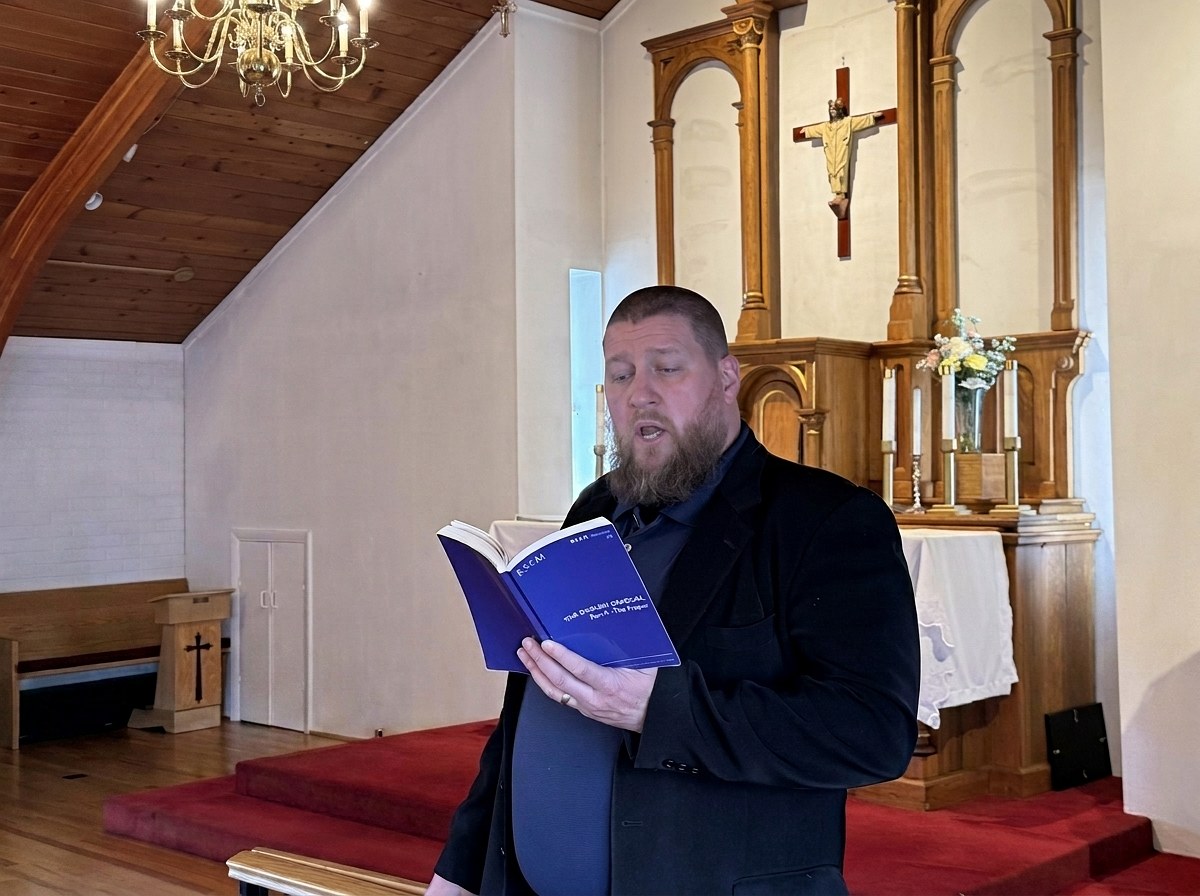
Michael Holmes has been serving that feeling, and offering it back to God, since he was twelve. That was the year he first sang as a cantor, the singer who leads a congregation in chant. He went on to earn a degree in musical theater and a minor in music; he has spent his life learning what a trained voice can do to a room. On most Sundays at St. Luke’s you will find him near the front of the nave, a chant book open in his hands, leading our sung prayer. (We are, in the interest of full disclosure, still short an organist — but a cantor needs only a voice and a reason, and Michael has never lacked for either.)
It Is Not a Performance
Michael will tell you that what he does on a Sunday morning looks, from the outside, like a performance: a practiced musician, a good voice, a roomful of people listening. What it is, in truth, is prayer.
The old word for the liturgy is leitourgia — “the work of the people.” The cantor does not stand apart from that work to be admired; he leads it from inside, the way a strong voice in a crowd helps everyone else find the note. Michael is not singing to the congregation. He is singing with them, and the whole of it is aimed past the room toward God. “Singing the Church’s music,” as he puts it, “is worship.”
Where the Voice Leads
The music Michael leads is mostly plainsong — the unadorned, unaccompanied chant that the Church has sung for the better part of two thousand years. It is sung prayer, and it connects us to a long line of worshippers who lifted the same kind of song long before any of us arrived. There is only the text, the breath, and the slow line of the melody carrying the words up.
Ask him for a favorite and he will tell you: the Passion — the sung account of our Lord’s suffering and death, chanted in the solemn days of Holy Week. It is among the most demanding things a singer can be handed and among the most consequential, and he loves it.
Raised in the Church, Michael came by both his faith and his love of its music honestly. But knowing a thing and being undone by it are two different things. The first time he truly felt the nearness of God, he says, was not from a pew but mid-chant — his own voice in the air, the words of the prayer leaving his mouth.
Come and Hear
You do not have to read music to be moved by it, and you certainly do not have to sing. Plainchant asks nothing of a visitor but to be present and to listen — though if the line is simple enough and the Spirit is willing, you may find your own voice has joined in before you decided to let it.
If you are in Colorado Springs and curious what sung prayer actually sounds like, come and hear it. We gather for Holy Mass every Sunday at 10:00 AM. Michael will be near the front, chant book in hand, doing the work of the people out loud.
Come and see — any Sunday at 10:00 AM. Plan your visit →